

Working the value gap
How artists help companies see beyond sameness, recognise emerging value, and build the imagination needed to stay distinctive.

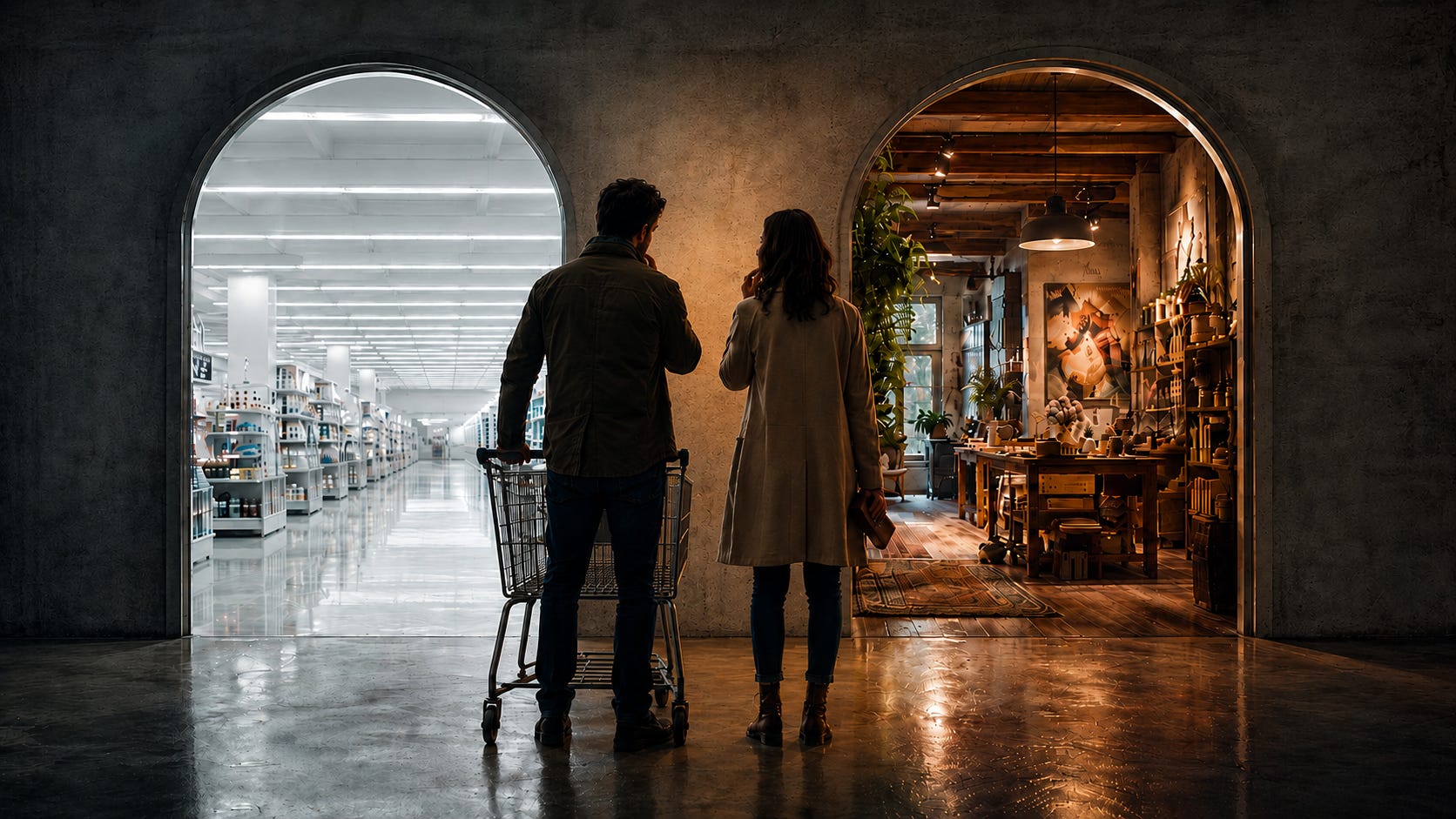
When abundance cheapens the commodities, the real and authentic becomes premium.
Customers are trading down where they can, comparing more carefully, accepting private labels with less hesitation, delaying purchases, and rejecting vague claims, all the while reserving their money for the products, services and experiences that feel genuinely worth more. Therein lies the value gap between the authentic and the generic, and the market is already punishing sameness. This process will continue.
The commercial question is how companies continue to create value when “good enough” keeps getting better. This is a demanding environment for every organisation that depends on preference at the point of purchase. Business can no longer assume that reasonable quality and fluent presentation will be enough, since competence has become abundant, and generic adequacy has improved. Familiar formats are easier to imitate, while digital tools, platforms, and now AI systems can produce large quantities of acceptable material at extraordinary speed.
McKinsey’s 2025 global consumer research captures the split. Globally, 79 percent of consumers surveyed were trading down, while more than a third had traded down in one category and planned to splurge in another. People under pressure are sorting their spending with greater discipline, cutting back where the difference feels small and paying more where the difference feels real.[1]
Private label shows the same movement from another angle. Most consumers see private labels as good-value alternatives to name brands, but still say they are likely to treat themselves by upgrading to a premium-brand product.[2] Cheap things are no longer automatically poor, generic things can be decent, available, well packaged and trusted enough for that card to be swiped. Any premium price now has to be earned through a difference people can perceive, and such perceived difference is the leading brand factor in share-price outperformance.[3] Visibility helps people recognise a brand. Difference gives them a reason to care.
Havas’ Meaningful Brands work gives an even keener edge: people would not care if 78 percent of brands disappeared tomorrow, while dynamic adaptability strengthens people’s attachment to brands by 2.3 times.[4] Behind those figures is a cultural condition most people recognise. We are surrounded by messages, offers, images, services and experiences that all seem polished and optimised, and essentially forgettable. A thing functions just fine, but does it create preference?
Value is therefore becoming inseparable from discernment. Organisations will need to sense when their own forms have become tired, when efficiency has stripped away character, when customers are accepting the offer but no longer feeling much for it, when innovation theatre has become a substitute for invention, and when the market is preparing to move before the spreadsheets have caught up with historical data.
This is where interaction with artists begins to look less like a cultural benefit and more like a business capability.
Artists are professional practitioners of sharp perception under conditions of uncertainty. They create meaning while working with form, resistance, rhythm, and tension, and make choices before the result can be 100% foreseen and justified. They follow weak signals and notice changes in atmosphere, appetite, behaviour and form before those changes become stable enough to be named as trends. They spend their working lives in the territory that business often reaches only multiple reviews and reports have arrived.
In an innovation context, creativity allows companies to move beyond optimised repetition, and allow imagination, and attention, to become tactical assets when the operating environment changes faster than what existing systems can process.
A company has a much larger sensory surface than any individual leader. Its people hear things, notice things, read things, sense things and absorb fragments of change through customers, suppliers, families, peers, social media, industry gossip and ordinary life, but the problem is that most organisations have few credible ways of collecting, interpreting and acting on those fragments, and pushing them up the chain of command.
Artists can help build that missing capacity. They can enter a company as outsiders with a particular sensitivity to signs, absences, repetitions and tensions. They can make the familiar visible again. They can help people look at the business from the edge rather than the centre, and create temporary situations in which different forms of intelligence become legitimate: visual, spatial, narrative, bodily, emotional, symbolic, observational and speculative. They can give employees permission to notice things the organisation has trained them to filter out in an effort to get .
The strongest innovation often begins in precisely that messy place. A routine becomes visible, a product category may reveal a hidden assumption, and a customer complaint will begin to sound like an early signal of changed values. At that moment a leader can recognise that the company’s definition of quality has become narrower than the customer’s definition of value.
This is the missing link between artistic interaction and measurable value. Artists help organisations perceive the conditions from which future value may emerge. The assumption is that they are best used as suppliers of motivational colour, decorative excitement or novelty. In truth, their real value lies in helping companies notice, interpret, imagine and test. In a market where difference has commercial value, that capacity has financial implications.
Data dealing with sustainability, repair and the circular-economy also belongs squarely inside this argument. Consumers are now willing to pay an average premium of 9.7 percent for sustainably produced or sourced goods.[5] European right-to-repair rules and circular-economy policy are pushing companies toward durability, repairability, reuse, waste prevention and longer product life.[6] IKEA’s buy-back, resale, repair and circular-service work extends the relationship between customer and company beyond the first purchase.[7]
These developments show that people are judging value across a longer arc - beyond routine considerations. Can the product be repaired? Can it last? Can it be reused, resold, recycled, returned, updated? Does the company remain present after the transaction? In all these cases, value becomes visible through continuity of attention.
That phrase, continuity of attention, belongs at the centre of the argument for artists in organisations. Artists are trained to sustain attention. They return to a material, a question, a phrase, an image, a sound until something yields, and the process can take a long time. They know how to stay with uncertainty without immediately reducing it to a deliverable. They know that the first answer is often the familiar answer, and that the familiar answer often carries the habits that created the problem, so it is not very useful in terms of being, you know, new.
A company trying to resist generic drift needs this kind of attention. It needs people who can ask why a service feels interchangeable, why a meeting format kills thought, why a workplace says one thing in its values statement and another thing in its physical environment, why customers admire the brand but buy from someone else, why staff comply while withholding imagination, why the product is technically excellent and culturally dull. They will ask the questions in their language, with their vocabulary, not what is familiar to the team. That is, in itself, valuable.
The same logic applies to experience. Mastercard’s 2025 European research, based on more than 15,000 consumers across 20 countries, found that most respondents (over three-quarters in each case) described checking off bucket-list activities as a priority, shopped around for deals before booking, and checked whether these experiences fitted their spending goals. Mastercard Economics Institute data also showed that live events accounted for 32.1 percent of European consumer spending on experiences in 2024, excluding travel and restaurants, up from 30.7 percent in 2019.[8] Following the limitations of Covid, that is hardly surprising.
Carefulness has raised the standard. People will still spend on travel, music, exhibitions, food, theatre, wellness, heritage, sport and encounters that promise memory and meaning. They will also compare harder, delay longer and reject anything that feels inflated, derivative or carelessly assembled. Experience commands value when it changes the texture of attention.
Companies have much to learn from that. A workplace can be experienced as a place of monotonous repetition or as a field of possibility. A training programme can be received as another demand on time or as an encounter that alters how people see their work. A leadership retreat can reproduce the same polished language as the previous year or open a space in which difficult questions can be asked without immediate defensiveness. The difference is rarely only the content. It is the form, the frame, the energy in the room, the quality of listening and the intelligence of the people brought into the process. And L&D leaders in smart companies listen for signs confirming the presence of such things.
Generative AI intensifies the pressure. When objects, concepts and decorative ideas can be produced in seconds, average output becomes more abundant. Some of it will be useful. Much of it will be derivative. A lot will be rather awful, but plenty will be competent enough to increase the volume of acceptable sameness.
Dentsu’s 2026 Consumer Vision study argues that as AI accelerates content creation, originality becomes more valuable, with consumers placing greater importance on human creativity and expecting brands to support and reward it.[9] Pew Research Center’s 2026 summary of American attitudes to artificial intelligence found that about half of U.S. adults thought AI would worsen people’s ability to think creatively and form meaningful relationships.[10] (None of this is any kind of surprising to a culture professional. I wrote about this phenomenon in 2025: https://thecreativefarm.substack.com/p/thoughtless-adoption-of-ai-will-make)
People will use AI where it helps - they already do. The premium will gather around the places where automated fluency cannot satisfy the desire for human intelligence, emotions, craft and empathy. A visually competent image may belovely but still feel empty. A fluent text may still lack judgement on second reading. Personalisation, the holy grail of much marketing, will feel generic if it is not truly personal. The easier it becomes to produce average material, the more valuable real discernment will become.
This is another reason to bring artists into companies. AI can generate options, help people judge which options have life in them and, of course, accelerate production. Artists can help organisations ask whether the thing being produced deserves to exist, and can there possibly be a better thing?
Innovation work needs that disturbance. The front end of innovation is foggy, provisional, contradictory and hard. Companies often want new ideas while protecting the habits that make arriving at those ideas unlikely. They ask for creativity, then process it through templates and incentives designed to reduce discomfort. Artists bring a different kind of rigour into that phase, since they are used to just starting, without full permission from the future.
Peter Robbins and Berit Sandberg’s work on art thinking argues that the front end of research and development needs more than the problem-solving orientation associated with design thinking. They present art thinking as a way of amplifying the “R” in R&D, using artistic practice to support inquiry before the problem is fully stabilised.[11] Sandberg’s study of an artist-in-residence programme at Robert Bosch GmbH is careful in its findings. The exchange with artists did not automatically create technological innovation in a narrow sense, partly because researchers did not always integrate artistic impulses into their working world. Yet the study points to the R&D environment as a fertile field for artists in business and demonstrates the importance of designing the bridge between artistic stimulus and organisational uptake.[12]
That bridge is crucial. An artist in a company does not create value by scattering inspiration like magic dust through the corridors. Value appears when the encounter is structured well enough for people to absorb difference without neutralising it too quickly. The artist must be present enough to disturb routine, trusted enough to be taken seriously, and free enough to retain the quality that made the invitation worthwhile. The company must be prepared to listen, translate, test and stay with uncertainty for longer than usual. Long enough to not fall back into the tried and the true.
Research on artistic interventions in organisations has been pointing in this direction for years. Ariane Berthoin Antal’s work treats artistic interventions as sources of organisational learning, creativity and altered perception, rather than decorative corporate culture projects.[13] Giovanni Schiuma’s work on arts-based initiatives argues that the arts can enhance value-creation capacity and business performance, challenging the one-way view in which business supports the arts while the arts have little to offer business.[14] A stronger claim is now easier to make: artistic interaction can help companies generate the kinds of difference that markets increasingly reward.
The existing practical model of artist engagement is important, of course. A painting in reception will make people feel better, but what I am talking about here is something deeper. A residency can alter the organisation’s sense of itself, a customised performance can create a shared disturbance in the firm, and a publication can turn a period of listening into an artefact that preserves attention in a physical form, not yet another damn digital thing that gets lost in the hard drives of participants as soon as it is distributed. A workshop led by an artist can make participants handle form, timing, voice, material, rhythm or space in ways that bypass the polished abstractions of management language. A long-form engagement can leave behind stories, practices and questions that continue working after the artist has gone. All of that adds layers of imaginative, attentive thinking.
This is where Art in a Place of Work should make its case. The programme belongs in the space between value, innovation and perception. Its purpose is to bring artists into companies as co-thinkers, observers, makers and catalysts, giving organisations structured contact with people whose working lives are built around attention, form, experimentation and meaning. The visible result may be a residency, workshop, talk, publication, internal programme, exhibition, event or long-term cultural process. The deeper result is a company with more sensitive antennae.
Those antennae work conceptually as well as commercially. A market report can tell a company what has already become measurable - an artist can help people sense what is becoming thinkable. A customer survey can reveal dissatisfaction - an artist can help expose the forms of deadness that produced it. A consultancy framework can organise known problems, while artistic interaction can help a company find the problem beneath the problem.
Luxury offers a warning in the context of value. A high price can signal value only when the experience, imagination and craft keep pace. Bain & Company reported in 2025 that the global luxury consumer base had fallen from about 400 million in 2022 to around 340 million in 2025, with new customer acquisition also down. Reuters’ reporting on Bain’s findings described shoppers as feeling alienated by years of price rises that were not matched by creativity - including both aspirational buyers and some very wealthy customers.[15] The market did not turn against excellence, but against the suspicion that price had outrun substance.
The same suspicion can gather around any organisation or any brand. A company may claim innovation while using safe, generic language so as not to sound too edgy. It may speak of people while offering deadening experiences to staff. It may promise quality while designing out care, or commission culture in ways that confirm the very sameness it hopes to escape. Customers, employees and partners have become skilled readers of these signals. They may not always be able to describe what is missing, but they feel the absence.
Intelligent brands are already reacting by making care more visible. Dove has committed to never use AI to represent real women in its advertising, extending its long-running Real Beauty platform into a more explicit position on authenticity in an AI-shaped visual culture.[16] European legislators are making repairability part of consumer rights, so brands in many categories are learning that people judge value through the surrounding system of care: how something is made, maintained, represented, supported, repaired, experienced and remembered. IKEA is building circular services into the customer relationship.
Artists can help organisations understand that system at a human level. They can read spaces, rituals, silences, habits and gestures. They can reveal where the company’s stated values are embodied and where they remain decorative, and create forms through which people feel authorised to speak, notice and imagine. And they can tell stories that are not “corporate storytelling” but real, engaging, authentic tales that carry editorial value, and not just advertorial buzz. Earned media, FTW!
The producer or curator role becomes essential in all this since business audiences are often - rightly - suspicious of airy claims about creativity. They need formats, timeframes, responsibilities, documentation and outcomes. The producer designs the frame, matches artist and company, translates across cultures, protects the integrity of the encounter and ensures that value is captured without reducing the process to a crude metric too early.
The commercial case should be made plainly. Companies that want to command attention, trust, loyalty and premium value need living sources of difference. Culture gives them a way to create those sources from the inside, and interaction with artists can help organisations become more observant, more imaginative and more capable of recognising value before the market has already priced it. That is a practical advantage in a world where acceptable sameness is cheap, fast, ubiquitous and exchangeable.
The companies with the strongest futures will learn to connect the many forms of value that the market is now separating from empty claims. Engineering, service, logistics, sustainability, repairability and price belong in the same system of value creation as beauty, story, atmosphere, memory, trust, imagination and human contact. The way a product is made, the way it feels, the way a customer is treated, the way staff are invited to think, the way an organisation listens, and the way it works with artists all contribute to perceived value.
Art In a Place of Work belongs in that system. It gives companies a structured way to resist generic drift. It helps them cultivate discernment before sameness becomes a visible commercial problem. By the time accounting has noticed, it is usually too late. Importantly, it brings into the workplace people trained to work beyond the horizon of the obvious, and asks the organisation to meet them there.
Footnotes
[1] McKinsey & Company, “State of the Consumer trends report 2025,” 9 June 2025. https://www.mckinsey.com/industries/consumer-packaged-goods/our-insights/state-of-consumer
[2] NIQ, “Private Label & Brand Growth – NIQ Global Outlook 2025,” 27 March 2025. https://nielseniq.com/global/en/news-center/2025/niqs-global-report-reveals-challenges-and-opportunities-for-private-label-and-branded-product-growth/. NIQ, “Finding Harmony on the Shelf: 2025 Global Outlook on Private Label & Branded Products.” https://nielseniq.com/global/en/insights/report/2025/finding-harmony-on-the-shelf/.
[3] Kantar, “Think Different: The DNA of breakthrough brand value growth,” 14 July 2023. https://www.kantar.com/uki/inspiration/advertising-media/think-different-the-dna-of-breakthrough-brand-value-growth. Institute of Practitioners in Advertising, “Why brand difference matters, and what you can do to drive it,” 13 September 2023. https://ipa.co.uk/knowledge/ipa-blog/why-brand-difference-matters-and-what-you-can-do-to-drive-it.
[4] Havas, “Meaningful Brands.” https://meaningful-brands.com/.
[5] PwC, “Consumers willing to pay 9.7% sustainability premium, even as cost-of-living and inflationary concerns weigh: PwC 2024 Voice of the Consumer Survey,” 15 May 2024. https://www.pwc.com/gx/en/news-room/press-releases/2024/pwc-2024-voice-of-consumer-survey.html.
[6] Directive (EU) 2024/1799 of the European Parliament and of the Council of 13 June 2024 on common rules promoting the repair of goods. https://eur-lex.europa.eu/eli/dir/2024/1799/oj/eng. European Commission, “Circular economy.” https://environment.ec.europa.eu/strategy/circular-economy_en.
[7] IKEA Global, “Our circular agenda.” https://www.ikea.com/global/en/our-business/sustainability/our-circular-agenda/. IKEA, “Buyback & Resell Service.” https://www.ikea.com/us/en/circular/buy-back/.
[8] Mastercard, “Europe’s Experience Economy is One for the Bucket List,” 26 March 2025. https://www.mastercard.com/gb/en/news-and-trends/press/2025/march/europes-experience-economy-is-one-for-the-bucket-list.html.
[9] Dentsu, “Dentsu Launches New Consumer Vision Study: ‘Mothers of Reinvention,’” 19 May 2026. https://www.dentsu.com/news-releases/dentsu-launches-new-consumer-vision-study-mothers-of-reinvention.
[10] Pew Research Center, “Key findings about how Americans view artificial intelligence,” 12 March 2026. https://www.pewresearch.org/short-reads/2026/03/12/key-findings-about-how-americans-view-artificial-intelligence/. Pew Research Center, “How Americans View AI and Its Impact on People and Society,” 17 September 2025. https://www.pewresearch.org/science/2025/09/17/how-americans-view-ai-and-its-impact-on-people-and-society/.
[11] Peter Robbins and Berit Sandberg, “Art Thinking: Amplifying the ‘R’ in R&D,” Journal of Innovation Management, 2023. https://journalsojs3.fe.up.pt/index.php/jim/article/view/2183-0606_011.001_L002.
[12] Berit Sandberg, “The Artist as Innovation Muse: Findings from a Residence Program in the Fuzzy Front End,” Administrative Sciences, 2020. https://www.mdpi.com/2076-3387/10/4/88. EconStor record https://www.econstor.eu/handle/10419/240078.
[13] Ariane Berthoin Antal, “Artistic Interventions in Organisations,” WZB report. https://www.wzb.eu/system/files/docs/dst/wipo/effects_of_artistic_interventions_final_report.pdf. Ariane Berthoin Antal, “Research on Artistic Interventions: A Learning Opportunity for the Social Sciences.” https://www.econstor.eu/bitstream/10419/207021/1/Full-text-chapter-Berthoin-Antal-Research-on-artistic.pdf.
[14] Giovanni Schiuma, The Value of Arts for Business, Cambridge University Press, 2011. https://www.cambridge.org/core/books/value-of-arts-for-business/5FD4C8694A0EEFA146AB303ECB0758FD. Giovanni Schiuma, “The Value of Arts-Based Initiatives,” Arts & Business Northern Ireland report. https://www.artsandbusinessni.org.uk/media/1199/2012-05-15-13-32-43-90-mapping-abis-prof-schiumafinal-1-1.pdf.
[15] Bain & Company, “Global luxury stays resilient despite economic headwinds and shifting consumer trends that reshape market,” 20 November 2025. https://www.bain.com/about/media-center/press-releases/20252/global-luxury-stays-resilient-despite-economic-headwinds-and-shifting-consumer-trends-that-reshape-marketbain--company-and-altagamma/. Reuters, “Luxury sector to revive in 2026 but price hikes leave shoppers ‘betrayed,’ Bain says,” 20 November 2025. https://www.reuters.com/world/china/luxury-sector-revive-2026-price-hikes-leave-shoppers-betrayed-bain-says-2025-11-20/.
[16] Unilever, “20 years on: Dove and the future of Real Beauty,” 23 April 2024. https://www.unilever.com/news/news-search/2024/20-years-on-dove-and-the-future-of-real-beauty/. Dove, “Real Beauty Pledge.” https://www.dove.com/us/en/campaigns/purpose/real-beauty-pledge.html.
 | A guest post by
|