The Theatre of Transformation vs The Reality of Structural Stress
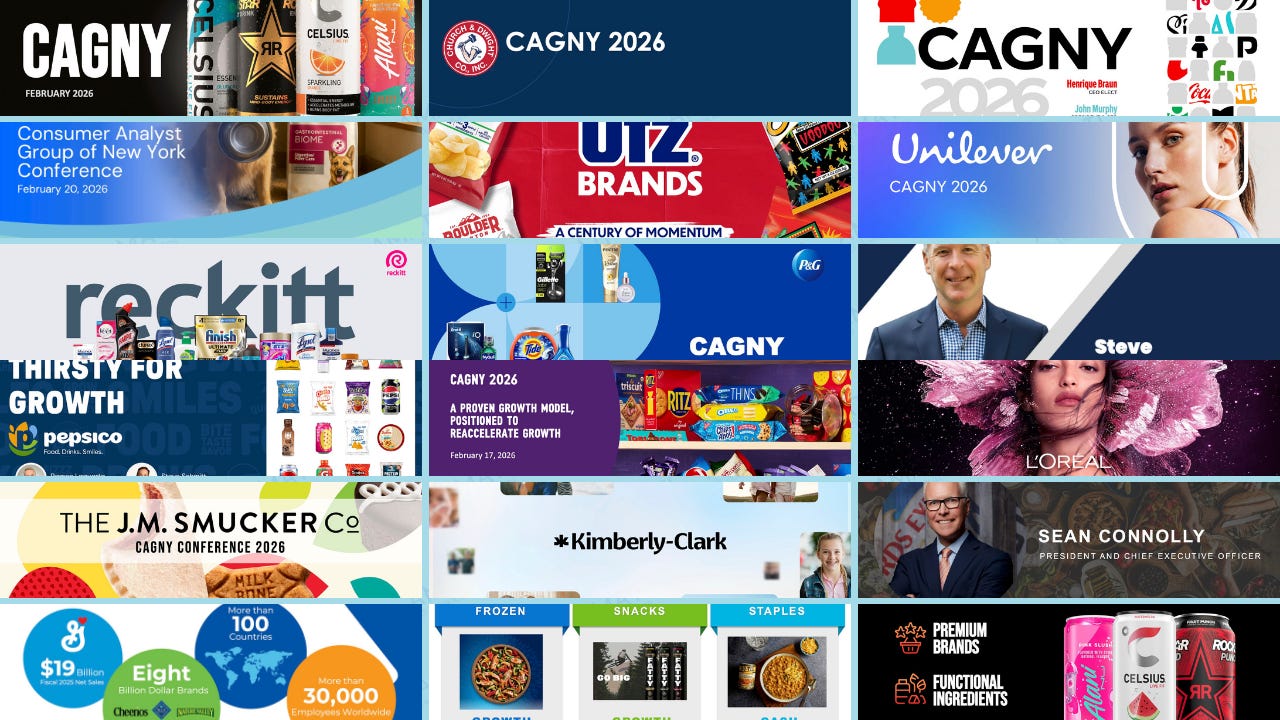
CAGNY 2026, my insights
The 2026 Consumer Analyst Group of New York meeting was framed as a moment of reset. Compared with the prior year, the language was more precise and less exuberant. Executives no longer relied on broad promises of transformation. Instead, they spoke in operational terms about agentic AI embedded into workflows, portfolios trimmed to core categories, reformulation around protein and functional benefits, retail media “clean rooms,” faster molecule-to-market cycles, and structural cost discipline.
This article was originally published on LinkedIn on Feb 22 2026
External analysts reinforced the sense of recalibration. Commentators described a defensive renaissance and a clear rotation of capital toward staples as a haven in a cooling but uneven economy. The prevailing narrative was that the sector had internalised the lessons of inflation, supply shocks and consumer fatigue, and was now responding with greater financial discipline and tighter strategic focus. The overall tone suggested maturity rather than ambition: an industry intent on stabilising itself before attempting to grow again.
Yet when one combines the corporate presentations, the sceptical post-CAGNY 2025 reflections, and the independent analyst synthesis, a different picture emerges. The gap between rhetoric and execution is narrowing in narrative but not yet in economics. The real signals are less about bold reinvention and more about an industry trying to stabilise a structurally weaker demand model while protecting margins built in an inflationary window that has now closed.
The uncomfortable truth is this. CAGNY 2026 did not signal a growth renaissance. It signalled an industry managing decline more intelligently.
1. The End of Pricing Power Was Known. The Volume Problem Is Structural.
The most important third-party consensus from Orlando was that the era of unconstrained pricing power is over. Inflation has cooled, and developed economies are expected to grow at a moderate pace. Yet consumer sentiment remains fragile and structurally lower than pre 2024 levels. The defensive rotation into staples reflects investor caution, not renewed growth confidence.
Executives openly acknowledged slower volume recovery. Some, such as General Mills, revised guidance downward. Others emphasised sequential improvement in the second half. But the core problem remains unresolved.
For three years, FMCG protected earnings through price and mix. Now the consumer is trading down, promoting more aggressively, and demonstrating what Deloitte termed a permanent value-seeking mindset, with 47 per cent of global consumers prioritising cost-conscious choices regardless of income. This is not cyclical frugality. It is a behavioural reset.
What is missing from most presentations is a credible volume creation strategy in a structurally lower-calorie, lower-indulgence, lower-impulse environment.
Price pack architecture was mentioned.
Portfolio simplification was championed.
But the industry has not yet shown how it intends to increase volume. If they do.
Shouldn’t they? Shouldn’t that be their priority?
The cost-volume-death spiral I expected after last year’s CAGNY remains unresolved.
2. GLP-1 Is Not a Headwind. It Is a Demand Shock.
Executives are no longer dismissing GLP-1 medications. That shift matters. Reuters and Bloomberg reporting highlighted that companies now view the impact as lasting rather than temporary. Data cited at the conference showed average calorie consumption down 40 per cent among users, dessert consumption down 84 per cent, and a potential 12 billion dollar hit to snack sales over the next decade.
This is not a flavour trend. It is a reduction in total addressable calories.
The dominant adaptation narrative at CAGNY centred on protein, fibre, gut health and compact packaging. These are logical responses. But they are defensive reallocations of shares within a shrinking category base.
What was missing was an honest reframing of long-term organic growth expectations for legacy high-calorie portfolios. If calorie intake per user declines structurally, the industry must either increase penetration, expand into new occasions or accept lower absolute volume. Most companies are still modelling modest organic growth rather than flat or negative total category volume in certain segments.
The bigger risk is not just reduced snacking. It is reduced habitual frequency. Energy drinks are celebrating increased usage occasions, but even there, the health framing dominates. Functional beverages are expanding because they justify consumption through purpose.
Traditional indulgence has lost its social licence.
CAGNY 2026 acknowledged the shift. It did not yet show a credible blueprint for thriving in a lower-calorie economy.
3. AI: From Slideware to Operating Model?
The most repeated phrase across presentations was agentic AI. Molecule to market. Structured data platforms. Clean rooms. Digital supply chain 3.0. Executives from Procter & Gamble described how constructive disruption and horizontal integration are enabled by AI. Analysts were broadly bullish on AI as a productivity engine.
There are early signals of substance. P&G is embedding AI across its value chain. Retail media optimisation through clean rooms is advancing. Some companies are meaningfully reducing R&D cycle times.
However, the scepticism from CAGNY 2025 still applies. The majority of the industry is not yet using AI to fundamentally reshape demand sensing, supply allocation or real-time pricing. The most common use cases remain productivity enhancement, marketing content acceleration and cost reduction.
AI is being deployed to defend margin, not to reimagine business models.
The real structural opportunity is to move from forecast-driven planning to demand signal-driven orchestration. That requires integrated data across retailers, direct-to-consumer channels and media ecosystems. Few companies demonstrated true end-to-end integration at scale.
The uncomfortable truth is that AI spend is high, but enterprise architecture remains fragmented. Agentic commerce was discussed. Few demonstrated live operating examples.
4. Portfolio Simplification Is Defensive, Not Visionary
A strong consensus emerged around portfolio cannibalisation for focus. Divesting low-growth, high-complexity categories is being rewarded by the market. Simplicity in volatile environments reduces execution risk.
This is sensible capital discipline. But it is also a signal of constrained ambition.
When scale becomes a liability rather than a moat, it suggests that growth complexity is no longer manageable under existing operating models. The shift towards category-killer focus reflects investor preference for predictability over bold adjacency plays.
In 2025, the narrative was transformation. In 2026, the narrative is simplification.
What is missing is a credible engine for building new platforms organically. Most health-led innovation is incremental reformulation or acquisition at high multiples. The criticism that M&A has become a substitute for capability building remains valid. Integration risk was openly questioned in cases such as Clorox and Kimberly-Clark.
Buying growth at 15 times revenue is not a strategy. It is financial engineering under pressure.
5. The Value Seeker Is Permanent. Premium Strategy Is Narrowing.
Deloitte’s provocation that the value seeker is structural is one of the most important signals. 35% of high-income households are now behaving in a cost-conscious way. That compresses the premium corridor.
Many companies presented bifurcated portfolios. Value brands to defend share. Premium brands to protect margin. This makes sense in a K-shaped recovery.
But the middle is hollowing out.
What was missing was a clear articulation of how brands create perceived value beyond price. Radical transparency was mentioned. Remarkability was invoked. Yet few companies showed evidence of a materially higher willingness to pay without promotion.
The industry still relies heavily on trade spend to drive short-term volume. Retailers, armed with their own data and private label expansion, are increasingly powerful gatekeepers. Agentic AI in retail media will favour those with superior first-party data integration. That is a small subset of players.
The real risk is commoditisation masked by branding language.
6. Emerging Markets: Acknowledged, Underfunded
Analysts agree that growth is shifting toward Southeast Asia and India. Disposable income and category expansion in these markets are projected to outpace developed regions significantly.
Yet the capital required to build a route to market, local manufacturing and culturally relevant brands is substantial. In a defensive rotation environment, shareholders are rewarding free cash flow and dividend stability.
This tension was visible but rarely confronted directly. Companies speak about emerging market opportunities. Few quantify the required reinvestment or the medium-term margin dilution.
The real signal is that developed market growth is structurally low.
Emerging markets are not an optional expansion. They are a necessity.
The risk is underinvestment driven by short-term earnings discipline.
7. The Cultural Undercurrent: Humanity vs Automation
One of the more subtle but important external signals came from cultural analysis. As AI flattens mass culture, evidence of humanity becomes a premium signal. Texture, imperfection and craft are increasingly markers of differentiation.
This creates a paradox. The industry is automating at scale while consumers increasingly reward perceived human authenticity.
CAGNY celebrated automation, molecule-to-market compression, and algorithmic marketing. It spent less time addressing how brands will maintain emotional distinctiveness in an environment where generative AI can produce infinite content at near zero marginal cost.
If everything becomes optimised, nothing stands out.
The missing conversation is brand meaning in an AI-saturated media environment. Performance marketing can drive short-term ROI. It cannot substitute for cultural relevance and long-term brand building.
8. Defensive Renaissance Is Not a Growth Strategy
The market rotation into staples, with strong year-to-date performance for defensive names, was framed as validation. In reality, it reflects macro caution and a search for dividend stability.
Investors are rewarding predictability, not bold growth.
The danger is complacency. A 13% ETF rally does not signal strong demand. It signals capital rotation.
If leadership teams interpret share price stability as an endorsement of strategy, they risk repeating the incrementalism that they failed to deliver after CAGNY 2025.
What Is Truly Missing
Across the combined narratives, five critical gaps stand out.
First, a recalibrated growth baseline. Few executives have reset long-term organic growth targets to reflect structural calorie reduction, permanent value-seeking, and retailer power. Hope remains embedded in mid single-digit algorithms.
Second, a credible consumer insight model for the GLP-1 era. Reformulating with more protein is reactive. The opportunity lies in understanding satiety psychology, portion economics and new consumption rituals.
Third, redesigning the operating model beyond cost take-out. Agentic AI should enable decentralised decision-making with centralised data intelligence. Most companies remain layered and slow.
Fourth, capital allocation transparency. If emerging markets are the future, boards must articulate how much margin volatility they are willing to accept to build a durable presence.
Fifth, honest communication. The theatre of transformation erodes credibility. Analysts are sophisticated. Boards are increasingly AI-enabled in governance. Signalling without substance will be punished more quickly.
The Real Signals for 2026
Strip away the language, and three real signals emerge.
(1) The consumer staples model is transitioning from price-driven margin expansion to productivity-driven margin defence.
(2) Total category growth in several legacy food segments will be structurally lower due to health intervention and behavioural change.
(3) Competitive advantage will accrue to companies that integrate data across the supply chain, media and product development rather than those that simply deploy AI tools within silos.
CAGNY 2026 was more sober than 2025.
There was less bravado.
More acceptance of constraint. That is progress.
But incremental improvement will not offset structural demand shifts. The industry must choose between defending historical economics and redesigning itself around a lower-calorie, more value-conscious, digitally mediated consumer.
Most presentations suggested optimisation of the old model with new tools.
Very few outlined a genuinely new model.
That is the uncomfortable truth beneath the polished slides.