

Poppi Didn’t Find a Magic Lever.
It Built Availability Until the Market Couldn’t Ignore It

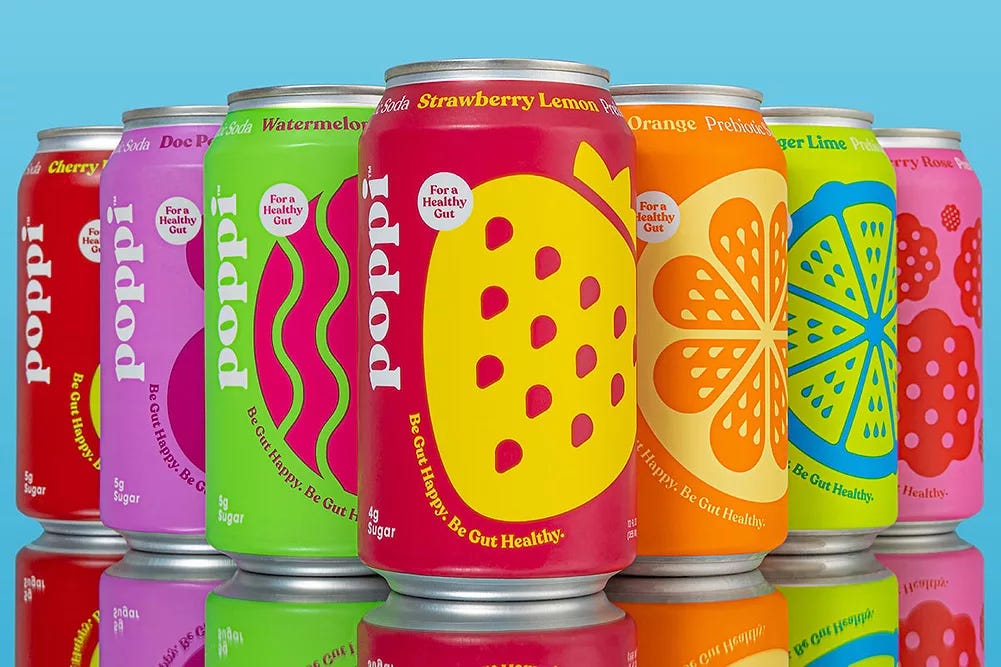
Poppi is often described as a modern success story in the beverage industry. The version that circulates most widely is simple and dramatic. A founder discovers a health remedy. A television appearance attracts a famous investor. Social media turns the brand into a viral sensation. A large corporation arrives with a billion-dollar acquisition.
Each element of that story is true. None of them explains how the brand actually grew. Between 2015 and 2025, Poppi moved from a homemade apple cider vinegar tonic sold at farmers’ markets in Texas to a national beverage brand sold in more than 36,000 retail locations. In 2025, PepsiCo agreed to acquire the company for $1.95 billion, bringing the brand into one of the world's largest beverage distribution networks.
Looking back, it is tempting to attribute that outcome to a single decisive moment. Some point to the appearance on Shark Tank in 2018. Others focus on a viral TikTok video that caused a sharp spike in sales. More recently, commentators have highlighted the Super Bowl advertisements and the influencer partnerships around Coachella.
These moments mattered. They did not create the brand.
The Poppi story becomes clearer when the timeline is examined carefully. Instead of one breakthrough, the company repeatedly increased two things that determine whether a consumer brand grows. First, people must remember the brand when a purchase occasion arises. Second, they must be able to find it easily when they decide to buy.
In marketing science, these ideas are known as mental availability and physical availability.
Poppi did not rely on a single marketing tactic to achieve them. The founders and their investors increased both forms of availability incrementally. Farmers’ markets created the first local distribution and awareness. Whole Foods provided credibility with health-conscious shoppers. Amazon's sales demonstrated national demand. Large retailers such as Target and Walmart then made the product widely accessible.
At the same time, the brand appeared repeatedly in cultural spaces where younger consumers were already paying attention. Social media creators, music festivals, sports sponsorships and eventually mass advertising all served the same purpose.
Each action made the brand slightly easier to notice and slightly easier to buy. The result was not sudden growth. It was an accumulation.
The Poppi story is therefore less about disruption than it appears. It is an example of disciplined brand building in a category dominated by some of the largest companies in the world. To understand why the brand succeeded, it is necessary to go back to the beginning. The first version of Poppi did not even compete with soda. It was simply a way to make vinegar drinkable.
