

Between Two Fires
FMCG’s 2026 Inflexion Point

The pricing era is over. Not slowing. Not adjusting. Over.
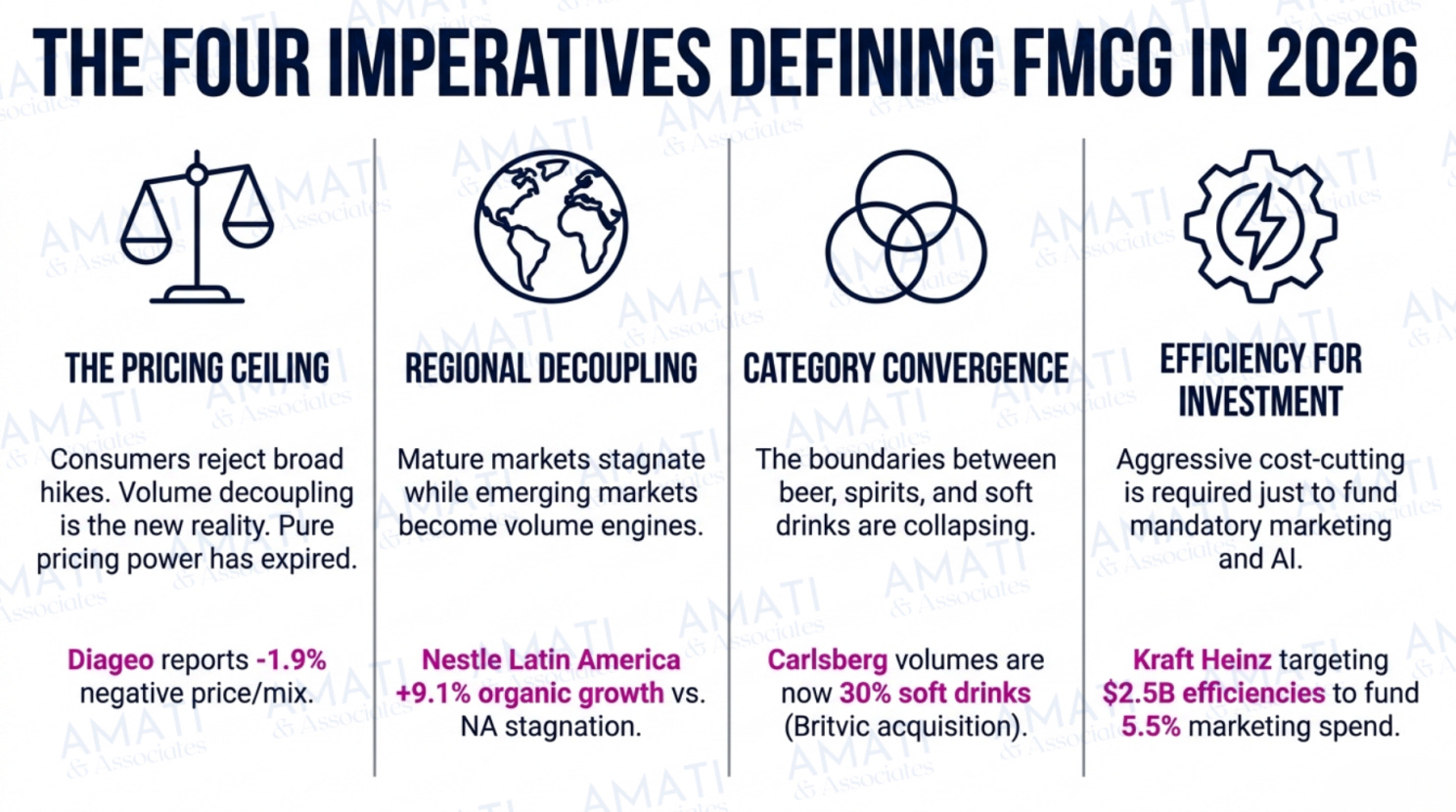
The Q1 2026 data from 14 of the sector’s largest companies leave little room for interpretation. Diageo posted a -1.9% price/mix as consumers aggressively traded down. Kraft Heinz recorded a -1.2% volume despite a so-called defensive pricing transition. Mondelēz International extracted +3.5% pricing — and watched -0.5% volume/mix eat into it. Across all three, the same dynamic: the elasticity threshold has been crossed, and pushing harder produces less, not more.
But here is the thing, the earnings headlines are not saying clearly enough. The industry is not stepping out of one crisis into recovery. It is stepping from one fire into another. Just as companies are being forced to moderate prices to claw back volume, a new cost wave is building on the input side — commodity super-cycles, geopolitical supply chain disruption, and tariff regimes that analysts are now calling structural, not temporary. And the hedges protecting the 2024 and 2025 results are expiring on schedule.
The companies that navigate the 2026–2027 period are those that understood early enough that both fires were coming, and simplified before the squeeze, not during it.
One hour. One strategic question. A sharper view of where your growth is actually going.
Most growth discussions focus on tactics. These workshops focus on the harder question: what actually drives profitable growth today?
Small-group workshops for senior FMCG leaders, led by Filiberto Amati.
Three topics run repeatedly throughout the year. €149 per session.
The Pricing Era Is Over. The Data Confirms It.
The consumer has bifurcated, and the bifurcation is now structural. At one end, Prestige Loyalists. Coty‘s Prestige division is holding 65% of total sales; L’Oréal Luxe is rebounding. These consumers are not leaving premium; they are doubling down on it, driven by what the sector calls “Treatonomics”: the prioritisation of small, affordable indulgences as a form of emotional relief in a financially stretched environment. At the other end: the Save-By-Choosing Shopper. The Coca-Cola Company is managing a deliberate 50/50 balance between price and volume through affordable mini-cans and localised packaging in Asia. These consumers have not abandoned brands; they are choosing the format that fits the budget.
In the middle: the Leaky Bucket. Molson Coors Beverage Company uses the term itself. The value segment is bleeding volume to both RTDs and private label. Mid-tier standard brands are not losing to a single competitor: they are being hollowed out from both sides. This is not a cyclical problem that promotional spend resolves. It is a structural realignment of where the consumer choice actually sits.
The mandate is not subtle. Broad price hikes are broken as a mechanism. The shift to surgical Price-Pack Architecture is no longer a best practice in Revenue Growth Management. It is the minimum viable tool for the current environment. And when new formats are difficult to implement, like in the spirits industry, price reduction becomes the new goal: Reuters reports that Diageo is planning to cut prices in the US, even on super-premium brands like Casamigos.
And then there is the layer that sits underneath all of this, which most companies are still treating as a consumer trend rather than a structural volume problem: GLP-1 and mindful consumption. Coca-Cola Zero Sugar surged 13% globally in Q1. Keurig Dr Pepper Inc. drove category growth entirely through zero-sugar reformulations. AB InBev put Corona Cero at the centre of its 2026 Olympics activation. Molson Coors’ Blue Moon Non-Alc entered the top ten within 12 weeks of launch. These are not niche signals. Zero sugar is no longer an alternative formulation. It is the default formulation in several beverage categories, and the companies treating it as an upsell are misreading the transition entirely
Not all players have been able to make the switch. Kenvue ‘s Q1 2026 saw organic sales growth of 0.7%, driven by a 1.0% benefit from pricing/mix that offset a 0.3% volume decline. Their Skin Health and Beauty segment was the clear growth engine, with net sales up 8.4% and volume up 4.2%. Conversely, the Self Care segment experienced a 2.3% organic decline due to a weak cold and flu season, though brands like Tylenol and Zyrtec still gained market share.
The Cost Squeeze Is Running on a Timer
While the demand side was reaching its ceiling, the cost side was building pressure from a different direction.
Three separate shocks have converged in 2026, and each has a different timeline.
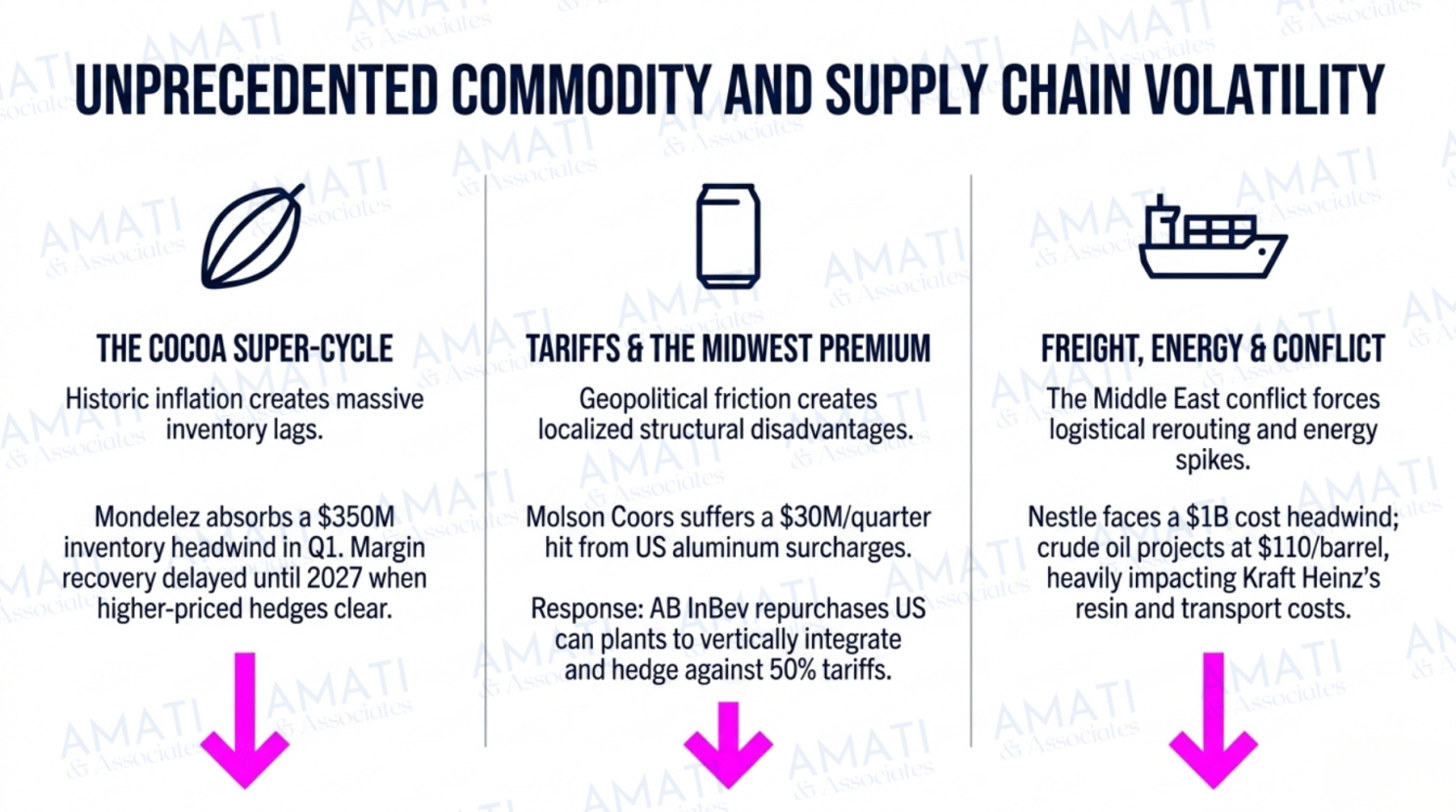
The first is the commodity super-cycle. The cocoa situation is the clearest example of a structural disruption being absorbed in real time. Mondelez took a $350M inventory headwind in Q1 alone. Margin recovery is not expected until 2027, when higher-priced hedges work their way through. Nestlé is facing a $1B cost headwind, with crude oil modelled at $110 per barrel, which flows through to petrochemicals, plastic resins, packaging, and freight.
The second is tariff-driven material inflation. Molson Coors is absorbing $30M in US aluminium surcharges per quarter. AB InBev’s response is instructive: the company repurchased its US can plants to vertically integrate and hedge against the 50% tariff. That is not a trading decision. It is a structural acknowledgement that the tariff regime is permanent and that exposure cannot be managed solely through procurement relationships. Kraft Heinz faces the same logic on resins and transport, and is responding with reshoring and industrial automation rather than assuming the tariff environment normalises.
The third is freight, energy, and the knock-on effects of the Middle East conflict. Shipping disruptions around the Strait of Hormuz have forced Mondelēz and Nestlé onto rerouted lanes that add weeks and cost to every container. Energy cost spikes then cascade into every cost line that uses heat, refrigeration, or hydrocarbon-derived inputs, which covers most of the sector’s product range.
What makes 2026 different from 2024 and 2025 is not the magnitude of these shocks. It is the timing. The hedges are expiring. Kraft Heinz’s plastic resin coverage runs only through the middle of Q3 2026. Procter & Gamble has already flagged approximately $1B in FY2027 profit impact from surging crude prices. Unilever revised its full-year cost inflation estimate upward by €350M to €500M. Carlsberg Group is covered through 2026, but is already communicating that aluminium, glass, and fertiliser cost ripple effects will persist into 2027.
This creates the precise dilemma that the industry does not have a clean answer to: raise prices again to cover the incoming cost wave and kill the fragile volume recovery that just started, or absorb the margin compression and burn the investment capacity needed to compete in 2027. Neither option is good. The companies with the fewest brands, the leanest supply chains, and the most localised manufacturing have the most room to manoeuvre. The ones still carrying portfolio complexity going into 2026 have the least.
Efficiency Is No Longer About Profit. It Is About Survival.
SGPPs or Strategic Growth and Productivity Programmes were designed to generate bottom-line profit improvement. In 2026, they are self-funding survival. The logic has inverted: cut operational costs not only to improve margin, but to release capital for marketing and technology spending that is now non-negotiable for operating.
Nestlé is executing 16,000 job cuts. The purpose is not efficiency for its own sake. It is to fund reinvestment across the 30-plus categories in which it intends to compete. Kraft Heinz is targeting $2.5B in efficiencies specifically to support 5.5% marketing spend and has increased marketing investment by 37%. Coty is deploying OpenAI’s Pencil to replace legacy marketing asset production: not as an AI innovation story, but as a cost reduction mechanism to fund real brand activity. These are growth programmes. But also, they are triage operations with a growth reinvestment output.
Unilever‘s model is currently the clearest articulation of what this looks like when it is working. The company is concentrating exclusively on 30 Power Brands, which are delivering +120 basis points versus the group average. The rest of the portfolio is not receiving the same level of investment; it is being managed toward divestiture or a minimum viable presence. This is the Shrinking for Growth logic at scale: reduce surface area, concentrate firepower, protect the positions that actually matter.
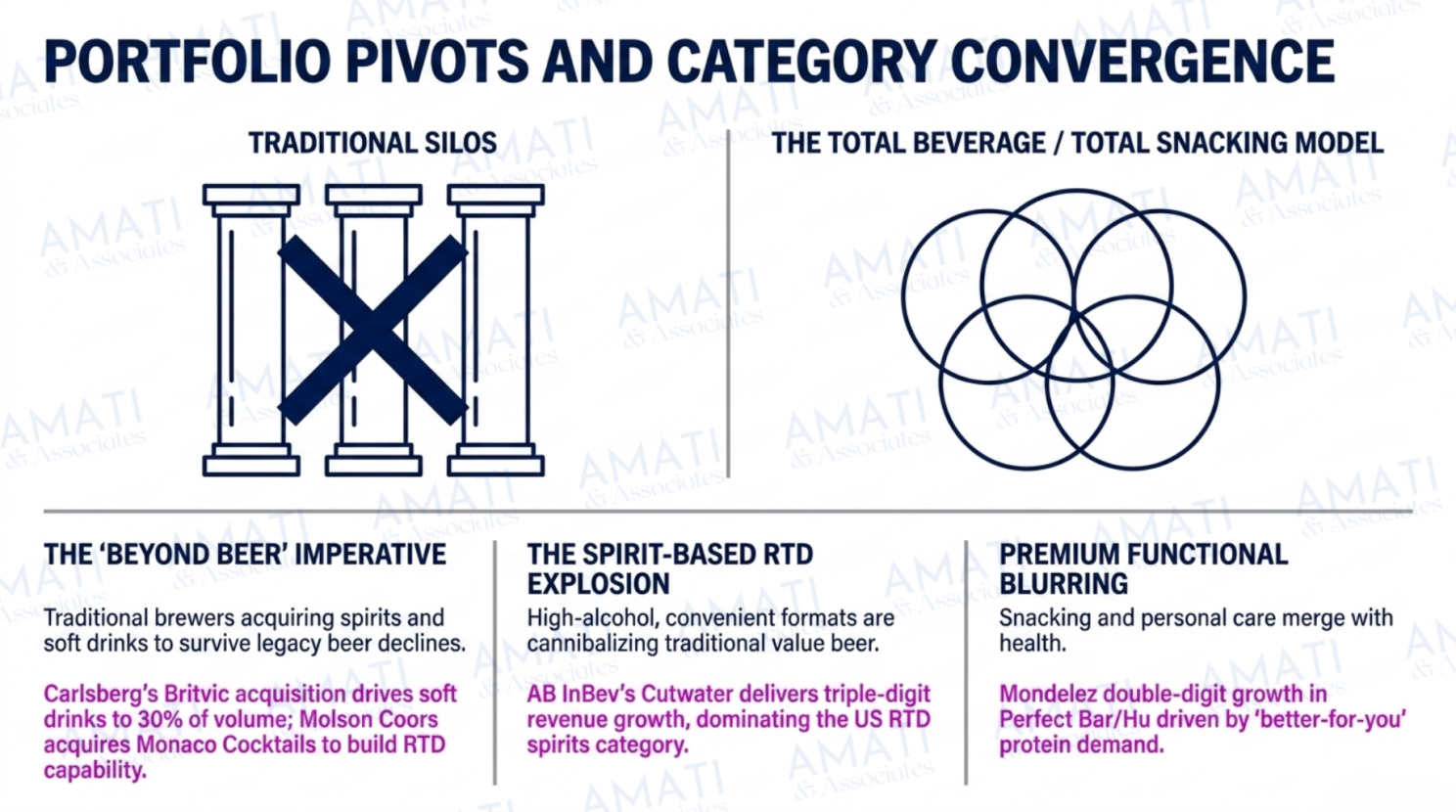
The category convergence fits into this same logic. Carlsberg’s volumes are now 30% soft drinks, following the Britvic acquisition. Molson Coors acquired Monaco Cocktails specifically to build further RTD capability. AB InBev’s Cutwater delivered triple-digit revenue growth, dominating the US RTD spirits category. These moves are not brand extensions. They are structural pivots away from legacy volume decline in traditional beer and toward adjacent consumption occasions that are growing. The Total Beverage model is no longer a strategic choice but a shared and structural response by companies whose core category is contracting and who need volume from somewhere.
The strategic benchmarking data make the divergence stark. AB InBev is posting +5.8% revenue growth, with BEES, its B2B digital platform, accounting for 72% of that growth. L’Oréal is delivering +6.7% LFL with a multi-polar geographic model. Unilever’s 30 Power Brands are delivering underlying volume growth of +2.9 %. On the other side: Coty posted a -7% LFL and took a $362.8M impairment in Consumer Beauty, executing what the company itself has named an emergency ‘Coty.Curated’ pivot. Diageo reported organic net sales down 2.8% in H1. The divergence between these positions is widening, and the companies on the wrong side of it face the 2027 hedge cliff with less margin buffer than the ones on the right side.
The Magnum Ice Cream Company is executing a €500 million productivity program to consolidate manufacturing and upgrade cold chain logistics. To combat health trends and GLP-1 drug adoption, the company is successfully leaning into portion-controlled, premium formats like Magnum BonBons. Kenvue reported an adjusted operating margin of 24.0% (a 420-basis-point improvement), largely driven by its “2026 Restructuring Initiative” which aims to deliver $200 million in annualized savings through supply chain optimization and reduced complexity.
The New Geography of Volume + the M&A Reality Check
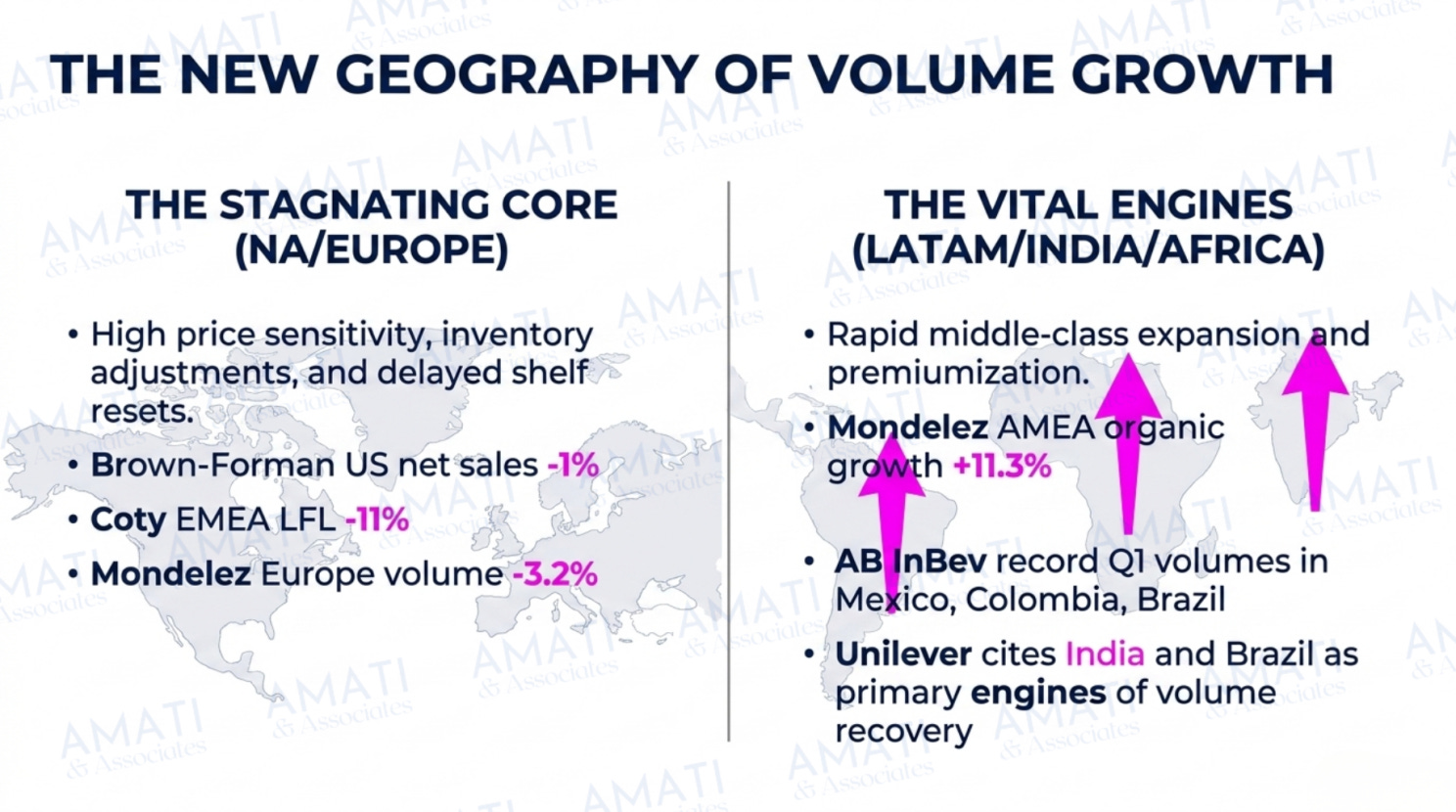
The geographic divergence in Q1 2026 is no longer a nuance. It is the primary structural fact behind FMCG growth.
Henkel achieved organic sales growth of 1.7% in Q1 2026, marking its third consecutive quarter of positive volume growth (+1.0%) alongside a 0.7% pricing increase. This signals a successful pivot away from purely inflation-driven pricing. Growth was heavily propelled by emerging markets, with Asia-Pacific (+10.3%) and IMEA (+12.8%) posting double-digit organic growth. In contrast, Europe contracted by 3.4% due to a construction slump and intense private-label laundry competition
The stagnating core is posting real numbers: Brown-Forman US net sales -1%, Coty EMEA like-for-like -11%, Mondelēz Europe volume -3.2%. North America and Western Europe are characterised by high price sensitivity, inventory adjustments, and delayed shelf resets. Promotional pressure is intensifying in markets where consumers have already exhausted their tolerance for price increases and private label has gained credible shelf positioning.
The vital engines are compensating: Mondelēz AMEA organic growth +11.3%. AB InBev is recording Q1 volume highs in Mexico, Colombia, and Brazil. Unilever explicitly cites India and Brazil as the primary drivers of its volume recovery. Nestlé Latin America is posting organic growth of +9.1 %, while North America is stagnating. These are not emerging-market bonuses layered on top of developed-market performance. They are carrying the growth number for companies that would otherwise be reporting flat or negative organic growth globally.
Geographic exposure is now a portfolio variable, like brand mix. Companies disproportionately weighted toward North America and Western Europe are structurally disadvantaged in the current environment — and the disadvantage compounds as the tariff and cost environment makes those markets simultaneously less profitable and less growable.
The collapse of the Pernod Ricard –Brown-Forman merger deserves a separate paragraph because it is the clearest illustration of what the M&A environment looks like when multiple structural pressures collide.
Three things killed it. Sazerac Company's $15B cash bid at $32 per share set an impossibly high valuation floor, creating a gap between what the deal was worth strategically and what the market was now willing to pay. Brown-Forman’s lack of geographic manufacturing diversity was then exposed in real time: a 60% sales plunge in Canada due to US trade wars materially altered the risk profile of the combined entity mid-negotiation. And the Brown family, holding 67% of voting power, prioritised heritage and board influence over deal terms, refusing the passive minority position that a merger into a centralised French conglomerate would have required.
The lesson is not that FMCG M&A is dead. It is that the conditions for a deal to close in 2026 are more demanding than they were in 2022 or 2023. Valuation gaps are harder to bridge when geopolitical shocks can move revenue numbers 60% in a single market within a quarter. And family governance structures that were compatible with stable growth conditions become friction points when the strategic urgency is existential. The next wave of consolidation (and it is coming) will be driven by sellers who have run out of options, not buyers who have found ideal targets.
Three Decisions That Cannot Wait Until 2027
The recent data points toward a 2026–2027 playbook with three non-negotiable moves.
The first is recalibration from broad pricing to surgical RGM. Pure pricing power is exhausted. The 50/50 RGM balance (e.g., defending the Leaky Bucket with localised value SKUs while simultaneously pushing Treatonomics formats, i.e., mini-cans, premium functional singles to protect margin) is the architecture that works in a bifurcated consumer environment.
The second is elevating the route-to-market. The core issue with the barbell strategy is not the portfolio logic itself, but the operating model underneath it. FMCG companies are trying to serve fundamentally different market spaces through the same organisation, despite the need for different routes to market, capabilities, cultures, and execution models. Standard brands depend on scale, distribution, and retail efficiency, while super premium brands rely on scarcity, storytelling, selective distribution, and luxury style relationship management. Companies like Diageo, Pernod Ricard, and Rémy Cointreau are each responding differently, whether through parallel structures, organisational separation, or product extensions into adjacent occasions. The common thread is that portfolio strategy alone is insufficient. The companies most likely to make the barbell work are those willing to redesign their operating model around it, with dedicated business units, differentiated capabilities, selective partnerships, and clear strategic trade-offs.
The third is integrating supply chain hedging as a permanent P&L instrument. Geopolitical shocks are structural. The companies treating the Strait of Hormuz disruptions, the aluminium tariffs, and the resin cost inflation as temporary headwinds to be managed through financial hedging are going to find the hedges expiring, leaving the structural costs in place. Vertical integration of vulnerable packaging inputs (AB InBev’s can plants), hyperlocalisation of manufacturing (Unilever’s proximity model), aggressive alternative sourcing (Mondelēz’s own cocoa-growing programme) — these are not risk-management options. They are the operational responses to a cost structure that has permanently changed.
The hedge cliff is not a 2027 problem to plan for. Kraft Heinz’s plastic resin hedges expire in Q3 2026. That decision needs to be made in Q2.
If you are running an FMCG company or division, the question is not whether the two fires exist. They do, and the data above describes them precisely. The question is whether your portfolio, your supply chain, and your investment capacity are positioned to absorb both or whether you are about to discover, at the end of year 2026, that they are not.
Originally published on my LinkedIn Newsletter